
Refrigerant Leak Detection & Repair · Urunga
Urunga's position at the Kalang and Bellinger river confluence produces one of the more diagnostic-demanding environments in the FHC service area — combined salt-air corrosion and estuary humidity mean reduced performance on a foreshore installation can present as low refrigerant when the actual issue is drainage, or vice versa. Behaviour-first testing under ARCtick licence AU069269 separates the two.
Refrigerant leak detection across Urunga combined salt-and-estuary systems
Foreshore and estuary-adjacent Urunga installations show refrigerant leak patterns driven by combined salt-and-estuary corrosion on outdoor condensers — pinholes on U-bends, terminal corrosion opening electrical-adjacent leaks, mechanical fatigue on refrigerant-circuit joints. Where the real fault turns out to be a drainage or humidity-driven issue rather than a genuine leak, the disciplined diagnostic sequence catches it before refrigerant testing wastes customer money on the wrong repair.
The Urunga customer base skews toward retirees and sea-changers who generally value plain explanations, honest quotes and no upsell. FHC's pricing matches — business-hours call-out is $132 AUD including the first hour of labour, additional labour and parts are quoted separately, and no broad repair prices are invented when the fault, parts and labour are unknown. A straightforward leak detection and repair is around 2 hours.
What FHC delivers on every refrigerant leak detection & repair
Refrigerant leak detection and repair is the service where diagnostic discipline matters most. Reduced heating or cooling performance is easy to blame on low refrigerant, but the actual cause is often something else: blocked filters, dirty coils, poor airflow, failed fans, faulty PCBs, zone-control problems, room-condition issues, or other electrical and mechanical faults. FHC tests the actual behaviour of the system first and only pursues a refrigerant diagnosis where the symptoms genuinely point there.
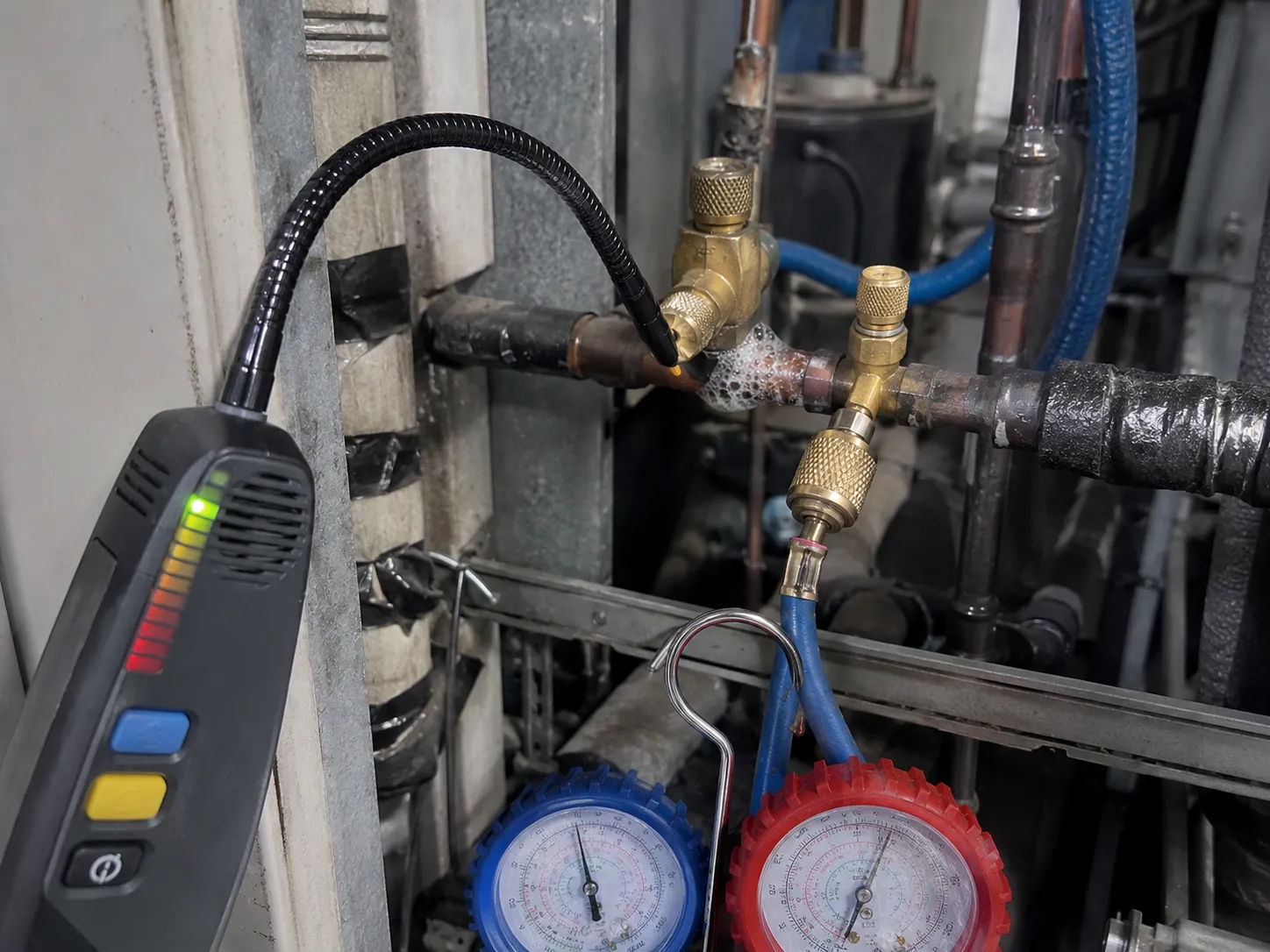
When a real leak is present, the process is: initial diagnosis, leak-testing, locating the leak where possible, repair of the leak where approved and accessible, pressure testing, correct refrigerant recharge, and final operational testing. A common customer misconception is that leaking refrigerant will have a strong or obvious smell — it does not, which is why proper testing is required rather than a nose-based check. Small or intermittent leaks, concealed or difficult-to-access leak locations, and extensive isolation testing can all extend job length considerably beyond the roughly 2-hour turnaround a straightforward leak-and-repair takes.
FHC holds an ARCtick licence (AU069269) covering all refrigerant handling, an air-conditioning and refrigeration licence, and $5 million public liability insurance. Business-hours call-out is $132 including the first hour of labour; additional labour, refrigerant, parts and repair materials are charged separately. A 12-month workmanship warranty applies where conditions apply. Refrigerant work performed by non-certified personnel is illegal in Australia — every FHC leak repair is completed within legal certification requirements.
Why FHC Refrigeration for refrigerant leak detection & repair
- • ARCtick licence AU069269 — refrigerant work by non-certified personnel is illegal in Australia
- • Behaviour-first diagnostic — reduced performance has many causes, not always low refrigerant
- • Written quote before work; business-hours call-out $132 AUD including first hour of labour
Frequently asked
Are Urunga installations really more prone to refrigerant leaks than straight-beachfront installations?
Foreshore and estuary-adjacent Urunga installations show a combined salt-and-estuary corrosion environment that's more demanding than either factor alone. Refrigerant leaks driven by outdoor condenser corrosion and by drain-line adjacent issues come up more frequently than at either pure beachfront or pure estuary-adjacent positions elsewhere.
Will I be able to smell a refrigerant leak on my Urunga aircon?
No. Leaking refrigerant does not have a strong or obvious smell, which is why proper testing is required rather than a nose-based check. The presenting symptom is usually reduced heating or cooling performance, not a smell.