

The Short Version
- Fujitsu fault codes narrow down where the problem sits. They don't name the failed part on their own.
- On some Fujitsu wired controllers,
E:EEorEE:EEis a prompt to retrieve a more specific code, not the fault itself. - Photograph the display and record the indoor, outdoor and controller model numbers before you reset anything. A reset wipes the information a technician needs.
- The same code can come from refrigerant, airflow, a sensor, a valve, wiring or a control board. Proper testing is what separates them.
- If the fault comes back after a reset or a top-up, the original cause was never found.
If your Fujitsu has stopped and put a code on the display, that code is useful. It just isn't the whole answer. Fujitsu fault codes tell you which family of problems to look at. They don't tell you which component has failed, and they don't tell you why it failed.
That distinction matters more than it sounds. Plenty of systems get refrigerant added or a board replaced on the strength of a code alone, then fault again a few weeks later. Here's what the display is really saying, what you can safely check, and where the line sits between a homeowner observation and technician work.
What Do Fujitsu Fault Codes Actually Tell You?
A Fujitsu fault code tells you which part of the system reported a problem, not what caused it.
Think of it as the system saying "something is wrong in the discharge temperature circuit" rather than "the discharge thermistor has failed." Those sound similar. They aren't. A discharge temperature fault can come from the sensor itself, from a genuine over-temperature condition, from a refrigerant problem, from restricted airflow, or from an electronic expansion valve that isn't opening properly.
The code narrows the search. Testing closes it.
This is why we don't quote a repair over the phone from a code. We can tell you what the code family usually points at, and we can tell you what we'd check first. Confirming it takes measurement on site.
What Does E:EE Or EE:EE Mean On A Fujitsu Controller?
On some legacy Fujitsu wired controllers, E:EE or EE:EE isn't the fault code at all. It's a status display that tells you the unit has stopped and that a more specific code can be retrieved.
Fujitsu General Australia's technical reference for the UTY-RNNYN wired controller sets out how this works. That controller supports a self-diagnosis function with a separate fault code display, listing distinct codes for serial communication, discharge sensor, pressure sensor and discharge temperature.
So the first display tells you something has stopped. The second display is the one that tells a technician where to look.
Here's the important caveat. Fujitsu uses several different controllers, and the retrieval method and code notation vary between them. A button sequence that works on one controller may do nothing on another. Two-digit controller codes, E:xx codes and indoor unit lamp blink counts are not interchangeable. So we'd rather you photograph what you're seeing than follow a sequence you found online for a different model.
What To Record Before You Reset Anything
A reset can clear the fault and the evidence at the same time. Before you touch anything, spend two minutes collecting the following:
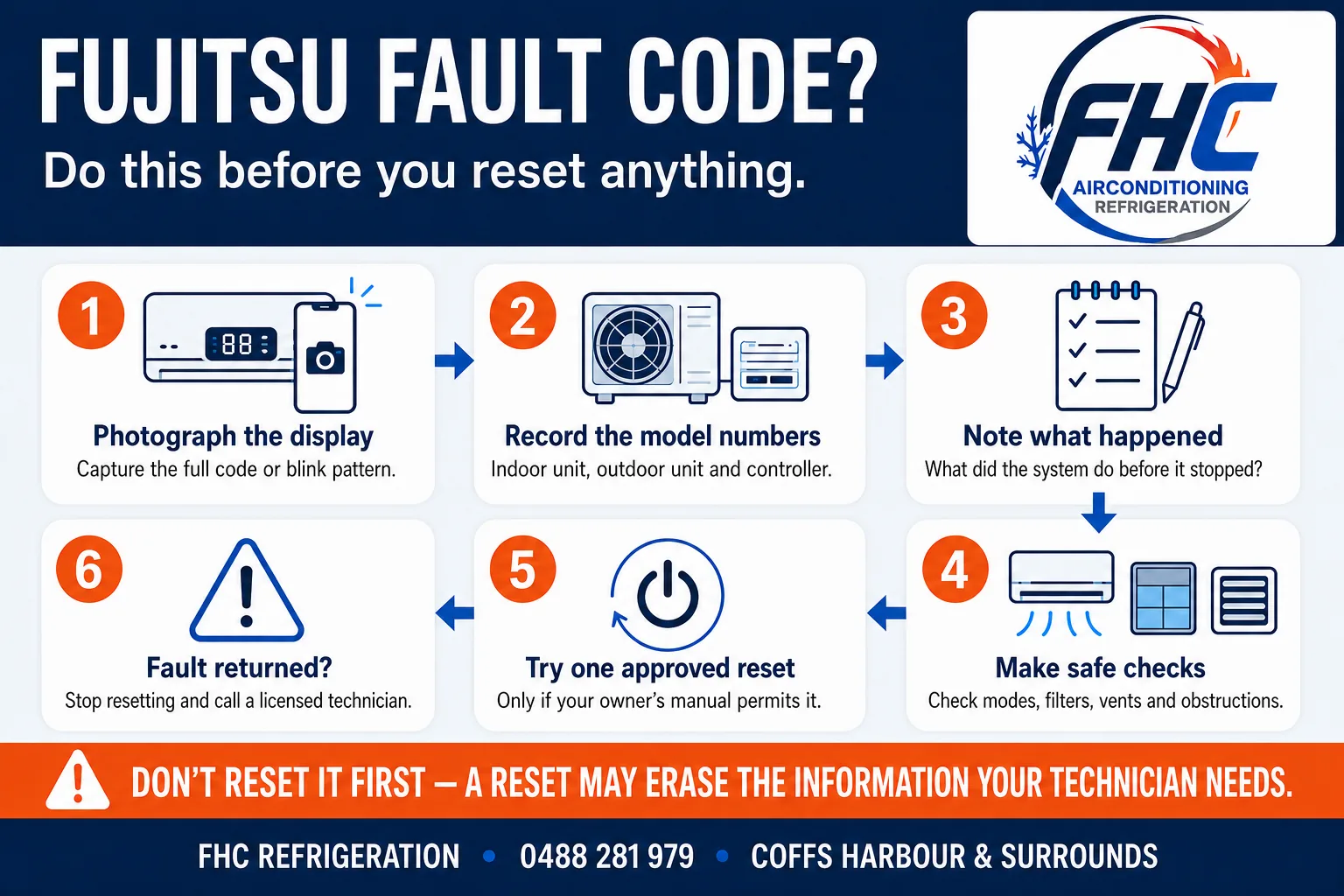
- A photo or video of the full display, including any blink sequence. Count the blinks and the pauses between them. The pattern matters, not just the number.
- The indoor unit model number. Usually on a sticker behind or under the front panel.
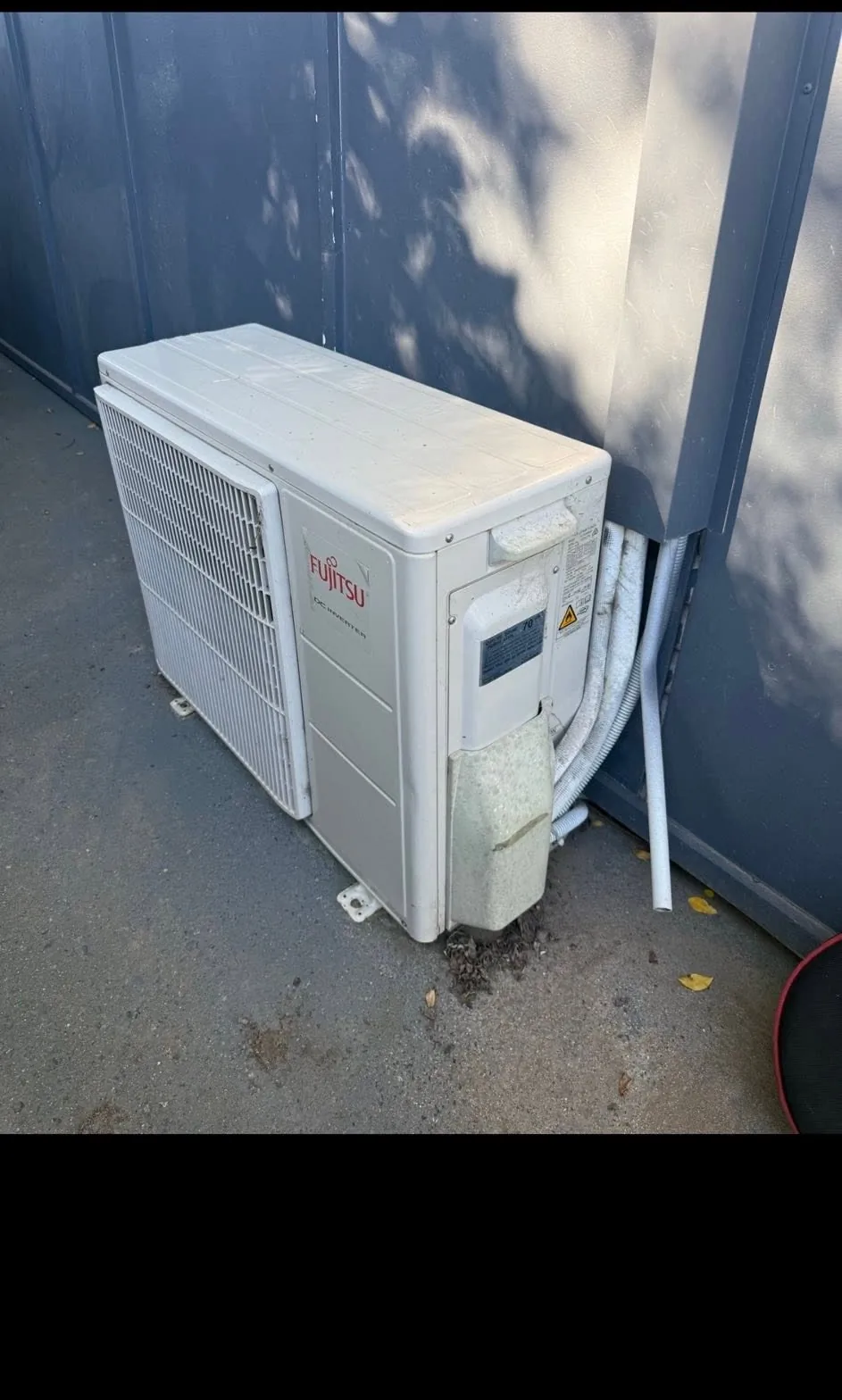
- The outdoor unit model number. On the plate on the side or back of the outdoor casing.
- The controller type. Wall controller, wireless remote, or a wired controller with a display.
- Which heads are affected, if you have a multi-head system. One head or all of them is a genuinely different diagnosis.
- What the system does before it stops. Does it run for 10 minutes then shut down, or never start at all? Does it heat but not cool?
- Anything that happened just before. A storm, a power outage, a tripped breaker, or a previous repair.
That last one gets overlooked and it's often the most useful. A fault that appeared the morning after a storm points somewhere quite different to one that's been building over a season.
Why Does The Same Fujitsu Fault Code Have Different Causes?
Because the code reports a symptom the system detected, and several different failures can produce the same symptom.
A good example: a technician on a no-cooling call started with a low refrigerant theory, which is where most people start. Then he compared the discharge line's actual temperature against what the sensor was reporting and found a large gap between them. The measured diagnosis pointed at faulty thermistors, not charge.
In a separate multi-head case with a communication error across several indoor units, testing found the expansion valves had failed, with a suspected power event as the upstream contributor. Same code family, completely different repair.
There could be several causes behind any given code, and the pattern in the field is consistent: the first theory is often wrong, and measurement is what corrects it.
The Fault Clusters We See Most Often
These are the common groupings and what we'd check in each. None of these are diagnoses. They're starting points.
| What you're seeing | What it could point to | What needs checking |
|---|---|---|
| Communication error between indoor and outdoor | Interconnect cable type or condition, poor terminations, conductor leakage, a power event, or a control board | The whole communication path, not just the boards. Cable suitability and isolation between conductors, not only end-to-end continuity |
| Discharge temperature fault or repeated shutdown | Refrigerant charge, discharge thermistor, pressure sensor, expansion valve, restricted airflow | Sensor resistance against the model's chart, charge verified by recovery and weight, airflow and fan operation |
| Cold air at the vents but the room won't hold temperature | Airflow, static pressure, duct design, dirty coil or filter, charge | Supply and return geometry, static pressure, coil and filter condition, cycle timing |
| Heats fine but won't cool | Mode conflict on multi-head systems, reversing valve not switching fully, expansion valve, charge | Every head set to a compatible mode first, then valve behaviour and measured performance |
| Fault across several heads after a power event | Mode conflict, communication circuit, outdoor board damage | The exact code recorded, communication circuit measured, event history |
On the communication group specifically, it's worth resisting the jump to a board replacement. A communication code on its own doesn't condemn a board, and if something upstream caused the fault, such as a damaged interconnect cable or a poor termination, fitting a new board without finding it can damage the replacement too. We'd rather prove the communication path first.
Does A Fujitsu Fault Code Mean The System Needs Refrigerant?
Not on its own, no. It's not always a refrigerant shortage.
Low charge is a real and common cause of weak cooling and discharge temperature faults, so it's always worth investigating. But it isn't the automatic answer, and modern inverter systems make it harder to judge than people expect. An inverter compressor changes speed constantly, so pressure readings taken at one moment don't mean the same thing they would on an older fixed-speed system.
Where charge is genuinely in question, the reliable method is recovering the refrigerant and comparing the weight against the system's specified charge. Training material for inverter split systems consistently favours weighed charge over judging by running pressures alone.
If a system is genuinely low, something let the refrigerant out. Adding more without finding the leak means you'll be back to the same place in a season or two. That's why refrigerant leak detection is part of the job rather than an optional extra.
What Can You Safely Check Yourself?
You can check anything that doesn't involve opening the equipment or touching electrical or refrigerant components.
That covers more than people think:
- Confirm every head is set to a compatible mode. On a multi-head system, one head calling for heating while another calls for cooling can stop the system without anything being broken.
- Check accessible filters, and clean them only in the way your owner manual describes.
- Look for anything blocking the return air, the supply vents or the outdoor unit. Garden growth against an outdoor unit is a common one on coastal properties.
- Note any visible frost, water, unusual noise or smell, without opening anything.
- If your owner manual permits a normal user reset, you can try one. If the fault returns, stop there and book an assessment. A fault that comes straight back is telling you something.
What isn't a homeowner job: opening electrical or board covers, moving any wiring or terminals, taking live measurements, connecting gauges, or anything involving refrigerant. Refrigerant handling is licensed work in Australia. FHC Refrigeration operates under Refrigerant Trading Authorisation AU069269, and that licensing exists because the risks are real.
Bench-level board work carries its own hazards. One demonstration of Fujitsu board diagnosis shows how easily component damage occurs when connectors are handled while the circuit is powered.
Why Doesn't A Reset Or A Top-Up Fix It Permanently?
Because neither one addresses the cause. They address the symptom.
A reset clears the fault state. If nothing else changed, the condition that triggered the fault is still there, and the system will trip again once it reaches the same point. Sometimes that's the next day, sometimes it's next summer when the load goes up.
Same principle with adding refrigerant. If the system is low, it's low because refrigerant escaped. Topping it up restores performance for a while and then the same decline starts again. That's not a repair, it's a delay.
Treat any fault that returns after a reset or a top-up as unresolved. The useful information is the pattern: how long it ran before faulting again, and whether the symptoms were identical. Bring that to the technician.
What Happens When We Come Out
We start with the code, the model numbers and your description of what the system was doing. That's why the recording step matters so much.
From there it's testing. Depending on what the code points at, that means measuring sensor resistance against the model's own data, checking the communication path properly rather than assuming a board, verifying charge by weight where charge is in question, and looking at airflow and static pressure on ducted systems where the room won't hold temperature.
We tell you what we found and what it will take to fix it before we do the work. If the finding is that the system is old enough that repair doesn't stack up against replacement, we'll say that too. It depends on the age, condition and cost of the repair.
FHC Refrigeration services and repairs air conditioning across Coffs Harbour and the surrounding areas, including Fujitsu systems. We're not a Fujitsu dealer, so we're making no claim about manufacturer authorisation.
We'll install Fujitsu if that's what you want. For new installs we usually recommend Daikin, Mitsubishi Electric or Midea, and the reasons are practical rather than about badges. Parts turn around faster on those three, which matters when a system fails in the middle of summer. They're also the systems we work on most often, and that familiarity shows up in how quickly a fault gets found. If you'd prefer something else, we'll fit it. We service and repair every brand either way.
Common Questions
Can you tell me what's wrong from the code over the phone?
We can tell you what the code family usually points at and what we'd check first. We can't confirm a cause without testing, and we won't quote a repair on a guess.
Is it worth repairing an older Fujitsu?
It depends on the age, condition and what the repair involves. A sensor is a different conversation to a compressor. Once we know what failed, we can give you honest numbers on both paths.
The unit works fine now. Should I still get it looked at?
If it faulted and then cleared, something caused it. Intermittent faults usually get worse, and they tend to fail properly on the hottest day of the year. Getting it checked while it's running normally is easier than getting it checked when it isn't.
My system was serviced recently and it's still faulting. What now?
Bring the details of what was done. A fault that persists through a service points at something the service didn't cover, and knowing what was already checked saves repeating it. Regular servicing reduces the chance of faults but it can't rule them out.
Does a blinking light mean the same thing as a code on the display?
Not necessarily. Blink patterns and displayed codes are separate systems, and the same blink count can mean different things across models and capacities. Count the blinks and the pauses, note your model numbers, and let the technician match it to that model's data.
If your Fujitsu is showing a fault code or has stopped cooling, record the display and your model numbers, then give us a call on 0488 281 979. We'll talk through what you're seeing and arrange an assessment.
For general repair information across all brands, see our air conditioner repairs and split system repairs pages.