

The short version
- Ice on your outdoor unit is not normal around here. Most advice online says it's a defrost cycle, but that's written for colder climates. On the Coffs coast it means something's wrong.
- Most heating failures come down to one of three things: the wrong mode, a blocked filter, or a genuine fault. Check the first two before calling anyone.
- On a Daikin you can pull the fault code yourself with a button sequence on the remote. On a Mitsubishi Electric you can't, the flashing light is as far as you get without a technician.
- If it heats weakly rather than not at all, that's more often a cleaning problem than a refrigerant problem.
- Coastal systems fail differently. Salt attacks the control board and the metal contacts long before anything looks wrong from outside.
Most air conditioning advice online about heating is written for gas furnaces. Pilot lights, ignition, heat exchangers. If you're in Coffs Harbour you almost certainly don't have one of those.
What you have is a reverse cycle system, which is a heat pump. It doesn't make heat, it moves heat from outside to inside, and that means it fails in different ways and needs different checks.
Here's what to look at, in order, and where the line is between something you can sort out yourself and something that needs a licensed technician.
Why is my air conditioner not heating?
In most cases it's one of three things: the system isn't in heating mode, airflow is blocked, or a component has failed.
Those aren't equally likely. Mode and airflow account for a lot of winter call-outs, and both are things you can check in a few minutes. Component failure is real, but it's worth ruling out the simple explanations first.
The one that catches most people isn't a fault at all, so start there.
There's ice on my outdoor unit. Is that normal?
Not on the Coffs coast, no. Around here it means something's wrong.
This is worth spelling out, because most of the advice you'll find online says the opposite. Search this and you'll be told your outdoor unit is running a defrost cycle, that it's normal behaviour, and to leave it alone.
That advice isn't wrong, it's just written somewhere else. Reverse cycle systems do have a defrost function, and in climates where winter mornings sit near or below freezing, it runs regularly and it's nothing to worry about. Most of the pages explaining it are American or European.
Coffs winter minimums sit around 8 to 10 degrees. In 8 years working on systems across the Mid North Coast, Clayton has never seen a split system ice up outside. Not once.
So if there's ice on your outdoor unit, don't file it under normal. Get it looked at. Following advice written for a colder climate here means leaving a fault running.
The same goes for the indoor unit, and this one applies year round. An indoor coil that freezes up is always a fault. A split system shouldn't be running cold enough for that to happen, so if it is, something has gone wrong: airflow, refrigerant charge, or a control problem.
Worth knowing that commercial refrigeration is completely different. Cool rooms and freezer rooms are designed to frost up and defrost on a schedule, several times a day. If you've got a cool room that isn't defrosting, that's its own problem and it needs a technician quickly. But that's refrigeration, not air conditioning, and the two get confused constantly.
What can I check myself before calling anyone?
Four things, in this order, and they take about 10 minutes.
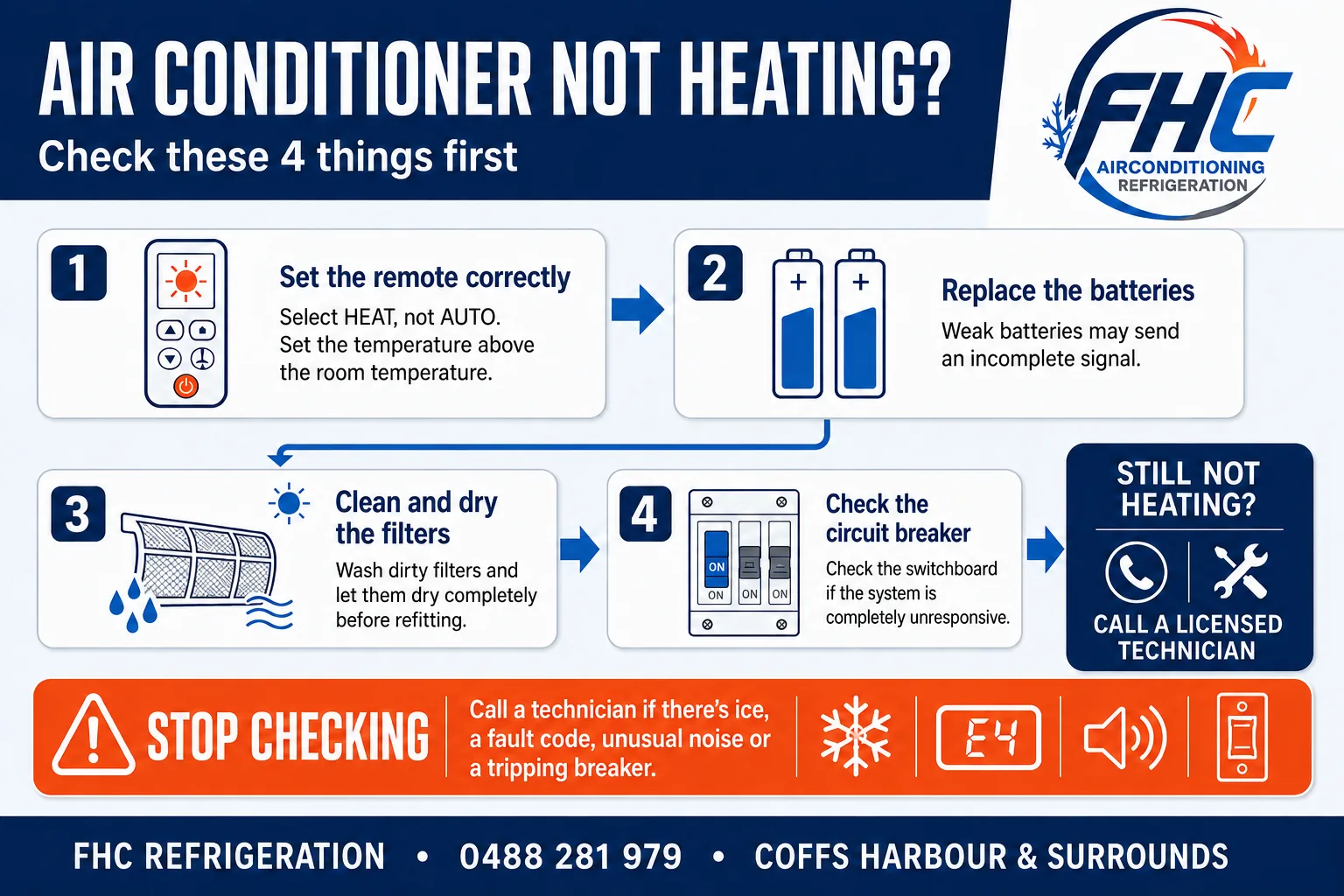
1. Check the mode on the remote. It needs to say HEAT, not AUTO. Auto mode decides for itself, and it doesn't always decide the way you want. Check the set temperature is actually above the room temperature too.
2. Check the remote batteries. Obvious, and it happens more than you'd think. A remote with dying batteries can send a partial signal that changes the mode without you realising.
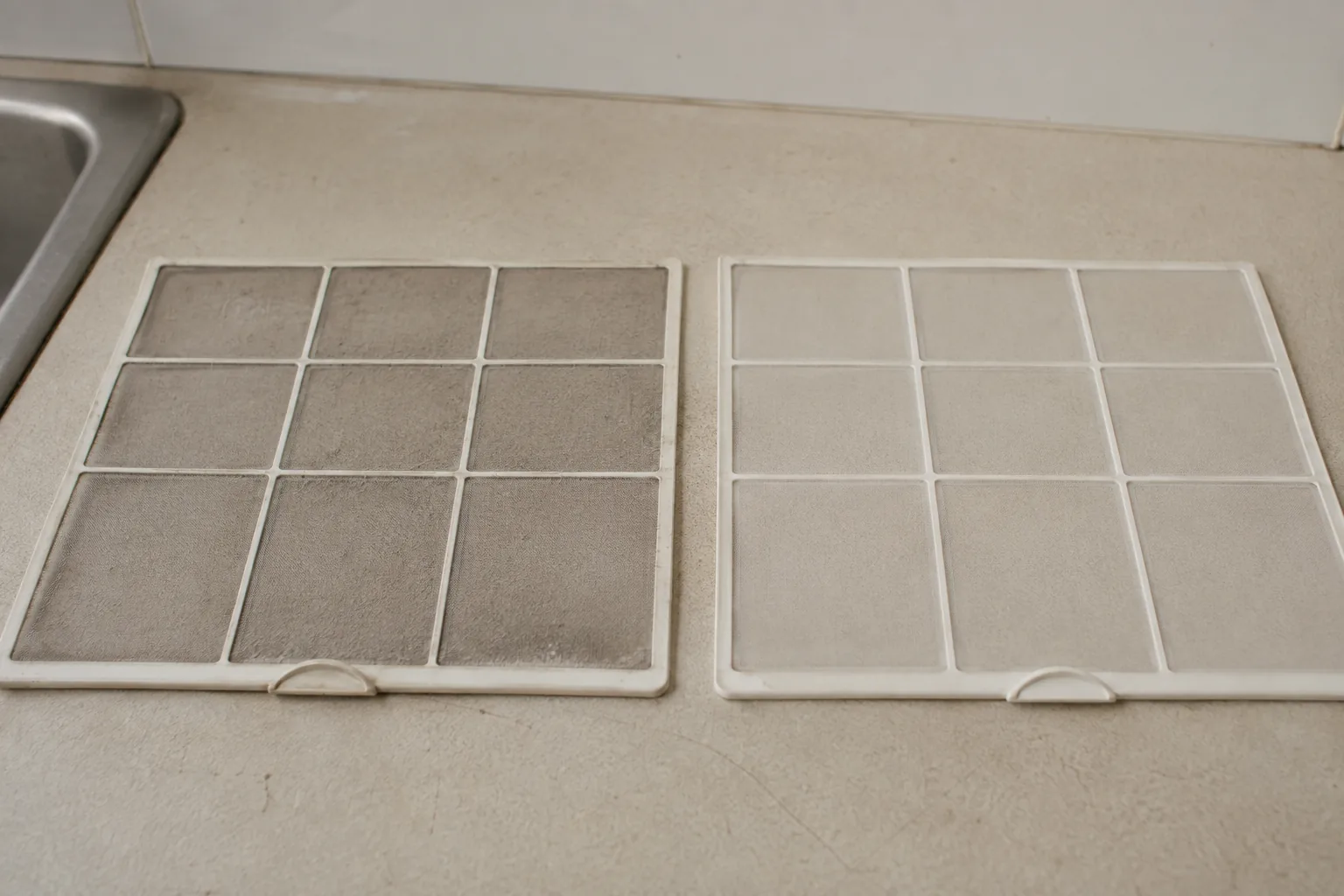
3. Pull the filters out and look at them. Lift the front panel on the indoor unit and slide the filters out. If they're grey and furry, that's your airflow problem. Wash them in warm water, let them dry completely, put them back. Do not run the system with the filters out.
4. Check the circuit breaker. If the outdoor unit is completely silent and the indoor unit isn't responding at all, check the switchboard.
If it's still not heating after those four, stop. The rest needs gauges and testing.
How do I find the fault code?
If you've got a Daikin, you can retrieve it yourself in about a minute. If you've got a Mitsubishi Electric, you can't.
Daikin, hand-held remote. Hold the cancel button at the bottom of the remote for around 10 seconds. The screen changes to show a two character code. Point the remote at the indoor unit that's flashing and press cancel to cycle through. Each press gives a short beep. When you hear a longer beep, stop. The code showing on the remote at that point is your fault code.
Daikin, wall controller. Easier. The code displays on the controller without you doing anything.
Mitsubishi Electric. The front of the indoor unit flashes to signal a fault, but there's no readable code you can pull yourself. Reading it needs a technician on site with the right equipment. If yours is flashing, that's the message: something's logged and it needs diagnosing.
Fujitsu. Fujitsu uses several different controllers, and the retrieval method varies between them. On some wired controllers, an E:EE display isn't the code itself, it's a prompt to retrieve a more specific one. Photograph what you're seeing and record your model numbers rather than following a sequence for a different model. Our guide to Fujitsu fault codes walks through what to record and what the display is actually telling you.
Write down anything you can get before you ring.
One thing worth understanding about fault codes: they tell you what the system detected, not always what's actually wrong. A code pointing at a sensor can mean a failed sensor, a wiring fault, or a control board misreading a perfectly good sensor. Testing is what separates those.
What actually fails on these systems?
Five things account for most residential repair work, and they behave differently.
Control board (PCB) failure. The brain of the system. When it goes, behaviour gets strange rather than stopping cleanly: modes that won't change, fans that run when they shouldn't, error codes that don't match the symptom.
Compressor failure. The expensive one. This is where the repair-versus-replace conversation usually starts, because on an older system the compressor can be worth more than the unit.
Outdoor fan motor failure. If the outdoor fan isn't turning, the system can't move heat in either direction. Often audible before it fails completely.
Mould and dust buildup. The system still runs. It just doesn't heat or cool the way it used to. This is the one that's entirely preventable.
Reversing valve failure. This is the winter-specific one. The reversing valve is what swaps the system between cooling and heating. When it fails, the system still runs, it just won't heat. It'll often throw a fault as well, because the indoor sensor reads the coil as cold when it should be hot.
It's not a common failure. A control board is the more likely culprit if a system won't heat. But it does happen, and it tends to show up the first time someone switches to heating for the season and finds it doesn't work.
That last one is worth stressing. If your heating has slowly got worse over a couple of seasons rather than suddenly stopped, it's more often a cleaning problem than a refrigerant problem. It's not always a refrigerant shortage.
Why do coastal systems fail more often?
Because salt attacks the electronics before it touches anything you'd notice.
On properties near the coast, corrosion shows up on the control board and the metal contacts. That's what causes the failure. The outdoor cabinet can still look reasonable while the board inside is well on its way out.
On a Sapphire Beach job this year, the base of an outdoor cabinet had been eaten away almost entirely and the condenser was packed with salt. Not because the brand was wrong or the unit was cheap, but because nothing had ever been done about the salt: no rust treatment when it went in, and no maintenance since.
If you're within reach of the surf, that changes the servicing interval and it changes what you should be asking your installer about.
When should I stop checking and call someone?
When the simple checks are done and it still isn't heating.
Specifically, call when:
- Mode, batteries, filters and breaker are all fine and it still won't heat
- The outdoor unit is iced up and stays iced up
- There's a fault code
- It heats weakly, and cleaning the filters didn't fix it
- The outdoor unit is making a noise it didn't used to make
- It's tripping the breaker
Anything involving refrigerant is licensed work. Handling refrigerant without a licence is an offence, and topping up a system that's lost refrigerant without finding the leak just means paying for the same gas twice.
Heating faults across Coffs Harbour, Sapphire Beach, Sawtell, Woolgoolga and the Mid North Coast. Call Clayton on 0488 281 979 with your fault code and what the system's doing, and you'll get a straight answer about whether it's worth repairing.